
Amplifier
Contact us for a SweepMe! Pro trial license!
What can an Amplifier do?
Signal Amplification: Amplifiers increase the strength of signals, making them more robust and easily detectable. This is particularly beneficial when dealing with weak or low-level signals, improving the overall signal-to-noise ratio.
Improved Sensitivity: By boosting the amplitude of signals, an amplifier increases the sensitivity of measurement instruments. This is especially valuable in applications where precise detection of small variations or low-level signals is essential.
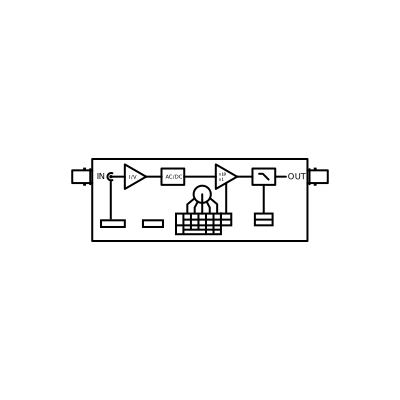
Current-to-Voltage Conversion: In measurement systems where sensors or devices produce a current signal e.g. photodetectors, a transconductance amplifier can convert these currents into proportional voltage signals and amplify them at the same time. The voltage signal can then be measured with a Lock-In amplifier or a Multimeter. This conversion is valuable because most measurement equipment requires a voltage input.
Where are Amplifiers implemented?
Test and Measurement Equipment: Amplifiers are fundamental components in various test and measurement instruments such as oscilloscopes, spectrum analyzers, signal generators, and multimeters. They help amplify and condition signals for accurate measurement, analysis, and characterization of electronic circuits and systems.
Data Acquisition Systems: Amplifiers play a critical role in data acquisition systems used for monitoring and recording analog signals from sensors, transducers, and measurement devices. They amplify weak signals, minimize noise, and improve signal-to-noise ratio to ensure reliable data capture and analysis in applications ranging from industrial monitoring to scientific research.
Telecommunications: Amplifiers are critical for boosting signals in telecommunications networks, ensuring reliable transmission over long distances and compensating for signal losses in cables and transmission lines, thereby maintaining the integrity of voice and data communication.
What are possible applications for Amplifiers?
Operational Amplifier (Op-Amp) with Photodiode: Transimpedance amplifiers can amplify the current generated by a photodiode in response to light. Photodetector applications, where precise voltage amplification is needed for light intensity measurements.
Lock-in Amplifier with Signal Generator: Combining a lock-in amplifier with a signal generator allows for the selective measurement and analysis of specific frequencies in the presence of noise. Signal demodulation in communication systems or analyzing modulated signals.
Fast Ionization Detection: In applications where rapid changes in ionization need to be detected, amplifiers with high bandwidth and fast response times are employed. These amplifiers ensure that the system can capture and process the rapid changes in the signal.
Preamplifier for Oscilloscopes, A/D Converters, and RF Lock-In Amplifiers: Preamplifiers are used in various measurement and analysis instruments to enhance the quality of signals before further processing. In oscilloscopes, they improve the visibility of signals, in A/D converters, they help in converting analog signals to digital with higher precision, and in RF lock-in amplifiers, they assist in extracting signals from noisy backgrounds.
Spectroscopy: In spectroscopy, the goal is to analyze the intensity of light at different wavelengths. Amplifiers are used to boost the weak signals from detectors, and the choice of amplifier depends on the sensitivity and resolution requirements of the spectroscopic system.
What are Important Specifications of Amplifiers?
Power output: Understanding the power output of an amplifier ensures it can drive speakers or headphones to desired volumes without distortion, enhancing audio clarity and fidelity.
Total Harmonic Distortion + Noise (THD+N): Lower THD+N values indicate cleaner audio reproduction with fewer audible artifacts, ensuring a faithful rendition of the original signal and superior sound quality.
Signal-to-noise ratio (SNR): A higher SNR signifies reduced background noise and clearer audio signals, particularly during quiet passages, enhancing overall listening enjoyment and detail.
Gains at different frequencies: Assessing gain variations across frequencies ensures consistent audio reproduction across the spectrum, enabling faithful rendition of both low and high-frequency content without distortion or loss of fidelity.
Impedance matching: Proper impedance matching optimizes power transfer between the amplifier and connected devices, minimizing signal reflections and ensuring efficient audio performance while preventing potential damage to equipment.
Bandwidth (Maximum frequency at which one has a certain gain): An amplifier's bandwidth determines its ability to faithfully reproduce signals across a wide frequency range, ensuring accurate audio reproduction of various content types with minimal distortion or attenuation.
Overload protection: Overload protection mechanisms safeguard amplifiers and connected equipment from damage by limiting excessive signal levels or responding to electrical faults, ensuring long-term reliability and preventing component failure.
Amplifier and SweepMe!
Instrument selection: Ensure that the equipment you purchase for your experimental setups can be remotely controlled, allowing seamless integration with SweepMe! software. If you encounter challenges in finding the right equipment, don't hesitate to contact us for assistance. Our team is ready to help you optimize your instrument selection for compatibility with SweepMe!.
Data visualization: The amplified signal is then displayed on the oscilloscope, providing a clear and magnified view of the signal's characteristics on SweepMe!
Device combination: With the combination of a transimpedance amplifier and a lock-in amplifier, SweepMe! offers enhanced capabilities for signal detection and analysis. The amplified signal, processed by the transimpedance amplifier, is meticulously processed by the lock-in amplifier, enabling precise measurements even in noisy environments.
Smooth workflow: For an integrated solution that maximizes efficiency and accuracy in your experiments, choose SweepMe! paired with a transimpedance amplifier and lock-in amplifier. Elevate your scientific endeavors with sophisticated instrumentation and intuitive software control. Contact us today to explore how SweepMe! can optimize your experimental workflows and propel your research forward.
Your partner for the integration
Amplifier support and integration
Built from real lab practice
SweepMe! was founded in 2018 by Dr. Axel Fischer and Dr. Felix Kaschura after their PhDs in applied physics. Since then the company has grown into a service oriented partner for industry and research alike, and more than 100 companies and research institutes run their measurements with SweepMe! today. We know what a measurement setup has to deliver, we make the technology work for you, and we understand the science behind your data.