
DAQ
Contact us for a SweepMe! Pro trial license!
Features of DAQ Loggers
DAQ Loggers handle voltage, current, temperature, pressure, and sound measurements with analog inputs. They capture voltage for electrical potential and current flow, monitor temperature changes via thermocouples or thermistors and track pressure variations with sensors. These capabilities make DAQ loggers indispensable across industries.
High Precision: DAQ systems are designed to provide high precision and accuracy in measurements, often featuring high-resolution ADCs that convert analog sensor signals into digital data with minimal error.
Multiplexing: DAQ systems typically support multiple channels, allowing simultaneous measurement of multiple parameters or sensors. This capability enables efficient data collection across various measurement points, reducing test duration and increasing productivity.
Signal Conditioning: Many DAQ systems include built-in signal conditioning circuitry, which helps amplify weak signals, filter out noise, and adjust signal levels to match the input requirements of the DAQ system, ensuring accurate and reliable measurements.
Real-Time Sampling and Streaming: DAQ systems can perform real-time data acquisition, sampling sensor signals at high speeds and streaming data directly to a computer or storage device. This real-time capability is essential for applications where rapid data acquisition and analysis are required, such as control systems and monitoring applications.
DAQ Channels
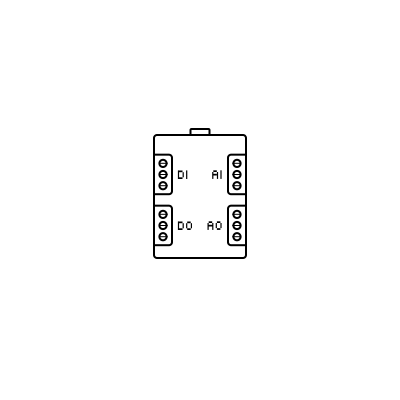
Digital Input (DI) channels on a DAQ device read the voltage level of an external signal and interpret it as either a low (0) or high (1) logic level. These channels are commonly used to interface with digital sensors, switches, or signals from other digital devices. Typical high voltage standards are 24 V, 10 V, 5 V, or 3.3 V.
Digital Output (DO) channels on a DAQ device allow for the control of external devices by switching the output voltage level between low and high states. They can drive relays, LEDs, or other digital actuators based on the logic level provided by the system. Common high voltage standards are 24 V, 10 V, 5 V, or 3.3 V.
Analog Input (AI) channels on a DAQ device measure continuous voltage signals with a given resolution, typically expressed in bits (e.g., 16-bit resolution). These channels are used to interface with analog sensors, transducers, or signals that provide real-world data in analog form. Measurement range variable between 0 V and different voltage standards.
Analog Output (AO) channels on a DAQ device generate continuous voltage signals within a specified voltage range. They can be used to control analog actuators, such as valves, motors, or variable speed drives, by providing the necessary control voltage.
0-24 mA Standard: Some DAQ devices support the 0-24 mA standard, an old industrial standard for long-distance sensor reading. The sensor creates a current between 4 mA and 24 mA or between 0 mA and 24 mA, proportional to the sensor value. An advantage is that voltage drops in long connection lines do not matter because the sensor maintains a constant current.
What measurements are possible with DAQs?
Interfaces: The digital and analog inputs allow easy interfacing with sensors of any kind to read out parameters. The DAQ outputs can control motors and machines by setting output voltages.
Integrated Circuit (IC) Testing: Verifying functionality, performance, and reliability of integrated circuits through precise measurements.
Linear range measurements: Interacting with machines to detect whether they are on or off, determining if certain states are high or low, controlling actuators, and reading sensor data.
Sensor networks: Reading out multiple sensors simultaneously.
Low-cost oscilloscope: Sample data of many channels to detect some events
What are the important specifications?
Number of channels indicates the maximum number of input or output channels the DAQ system can support which determines the capacity for simultaneous measurements.
Resolution represents the smallest change in the input signal that can be detected. A higher resolution allows for more precise measurements. For example, a 16-bit resolution divides the measurement range into 2^16 = 65536 steps.
Sampling Rate defines how quickly the DAQ system can capture and digitize analog signals, which enables capturing fast-changing signals accurately.
Data Transfer Interface: The type of interface (e.g., USB, Ethernet, PCI) for transferring data between the DAQ system and the computer.
DAQ and SweepMe!
Easy Implementation: SweepMe! contains drivers for many DAQ devices to get you started with your measurements.
Parameter control: SweepMe! Allows for easy access of all DI/Do and AI/AO connections.
Data visualization: Building your own Dashboard using the SweepMe! GUI to quickly display all parameters.
Automation: Automate high-dimensional parameter variation using the SweepMe! Sequencer.
Your partner for the integration
DAQ support and integration
Built from real lab practice
SweepMe! was founded in 2018 by Dr. Axel Fischer and Dr. Felix Kaschura after their PhDs in applied physics. Since then the company has grown into a service oriented partner for industry and research alike, and more than 100 companies and research institutes run their measurements with SweepMe! today. We know what a measurement setup has to deliver, we make the technology work for you, and we understand the science behind your data.