
Filter wheel
Contact us for a SweepMe! Pro trial license!
Types of filters
Bandpass Filter allow a specific range or "band" of wavelengths to pass through while blocking others. Commonly used in applications requiring isolation of a particular spectral region.
Long Pass Filter permit transmission of longer wavelengths beyond a designated cutoff point, effectively blocking shorter wavelengths. They are useful for applications where short wavelengths need to be filtered out.
Short Pass Filter are complementary components to long pass filters, to allow transmission of shorter wavelengths.
Notch Filter suppress or "notch out" a specific narrow band of wavelengths, allowing the rest of the spectrum to pass. They are commonly employed to eliminate unwanted interference or specific spectral lines.
Neutral Density Filter reduce the intensity of all wavelengths of light uniformly. They are employed for applications requiring precise control over light intensity without affecting its spectral composition.
Laser Filter are specifically designed to isolate or enhance certain wavelengths associated with laser sources. They ensure the transmission of laser light while blocking ambient or unwanted wavelengths.
Ultra-thin Filter are characterized by an exceptionally thin design, these filters minimize optical distortion and ghosting. They are ideal for applications where compactness and minimal impact on image quality are essential.
Which measurement modes exist?
Wavelength Selection: Precisely choose specific light wavelengths, varying from red to blue, and the ability to remove specific wavelengths.
Filter Transmission: Assess how efficiently optical filters transmit targeted wavelengths, involving variation in optical densities, represented by OD-Filter, OD1, and OD2.
Filter Positioning: Accurately position filters in a stacked wheel for optimal alignment, ensuring precise control over the transmitted light.
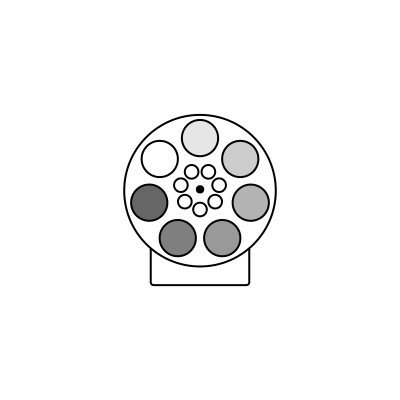
Stacked filter wheel: Utilizes a series of filters in a single device, providing dynamic control over light wavelengths and facilitating functions like Wavelength Selection and Filter Transmission.
Applications
Spectroscopy: Used to analyze the spectral characteristics of materials, aiding in chemical and molecular identification.
Material Science: Applied in material analysis, to study how materials interact with specific wavelengths of light.
Photometric Measurements: Used in various photometric applications, ensuring accurate measurement of light intensity.
Fluorescence Microscopy: Facilitates precise control over excitation and emission filters, enhancing fluorescence imaging in biological and medical research.
What are the important specifications of filter wheels?
Filter capacity describes how many different filters can be build in, typically 6-12. It determines the versatility of the filter wheel, allowing users to select a configuration based on their specific experimental or imaging needs.
Speed is critical for efficiency in experimental setups or imaging processes, as faster rotation reduces the time required to switch between filters.
Dimension of the filters are 12.5 mm and 25 mm in diameter, specifying the length of the filter. This information denotes the size of filters that are compatible with the wheel, ensuring proper fitting and alignment within the optical system.
Filter wheels and SweepMe!
Automation: SweepMe! offers a user-friendly interface for controlling experiments and automating measurements involving filter wheels.
Device combination: Combine your filter wheel with other devices implemented in SweepMe!, such as lasers, optical choppers, and spectrometer
Your partner for the integration
Filter wheel support and integration
Built from real lab practice
SweepMe! was founded in 2018 by Dr. Axel Fischer and Dr. Felix Kaschura after their PhDs in applied physics. Since then the company has grown into a service oriented partner for industry and research alike, and more than 100 companies and research institutes run their measurements with SweepMe! today. We know what a measurement setup has to deliver, we make the technology work for you, and we understand the science behind your data.