
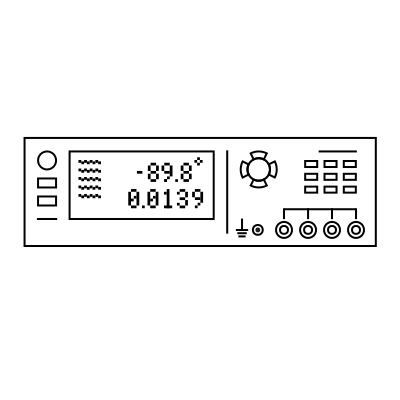
LCR meter
Contact us for a SweepMe! Pro trial license!
What does an LCR meter measure?
Capacitance (C) is the ability of a component to store electrical charge.
Resistance (R) quantifies the opposition to the flow of electric current in a component.
Inductance (L) gauges the ability of a component to store energy in a magnetic field when current flows through it.
How does the LCR meter work?
The LCR meter applies an oscillating voltage signal with known amplitude and phase to the investigated device. Then, the resulting current is measured. From its amplitude and the phase shift, the impedance is calculated which consists of a real part (resistance) and an imaginary part (reactance).
Additional parameters such as Capacitance or Inductance can be calculated from the impendance under the assumption of an equivalent circuit in a post-processing step. Most instruments evaluate these parameters for simple series or parallel RC circuits.
Which measurement modes exist?
Impedance analysis: Evaluation of the impedance characteristics, providing insights into the overall behavior of electronic components. Once the impedance is measured it can be modelled with an equivalent circuit to derive further properties.
Phase angle measurements: Assessing the relationship between voltage and current waveforms, which helps understanding phase differences in reactive components.
Inductance evaluation: Precise measurements of inductance values are essential for designing and analyzing inductive components in various applications.
Voltage sweeps CV: Measuring the capacitance over bias voltage yields capacitance-voltage characteristics. For example, such CV curves can be used to measure the change of a depletion zone in a semiconductor device.
Frequency sweeps Cf: Examination of component behavior across different frequencies. Such Cf curves can be used to analyze traps in semiconductor devices or to figure out from which frequency a series resistance starts to take effect.
LCR meter Applications
Electronics Manufacturing: Ensuring component quality and reliability by measuring properties like capacitance, resistance, and inductance.
Semiconductor Device Testing: Characterizing passive components integrated into semiconductor devices for performance evaluation.
Power Electronics: Testing components like transformers and inductors in power converters and motor drives for optimal performance.
Consumer Electronics: Troubleshooting and testing electronic devices like smartphones and laptops for proper functioning.
What are important specifications of LCR meters?
Frequency range: The most important specification, which determines the range of frequencies at which the meter can operate. Depending on the application, this can vary from low-frequency circuits to high-frequency devices.
Measurement resolution: The better the resolution of the LCR meter, the better it can resolve high impedance values as typically needed at low frequencies.
Bias voltage: The LCR meter is capable of measuring electrical components even when the circuit is not at zero volts, this is particularly useful for analyzing the behavior of components in real-world conditions, where they may be subjected to varying voltages or DC bias. The bias voltage range should thus cover the operation range of the device under test.
Current mode: An LCR meter with a constant current source can apply a stable and predetermined current to the device under test (DUT) during measurements.
Active Level control: Some LCR meter are capable of actively adjusting the output voltage to ensure the correct voltage is applied at the device under test (DUT). This feature helps to optimize measurements by compensating for variations in the DUT or the testing environment, ensuring that the voltage across the component is controlled and consistent.
4-wire connection: Precise instruments come with a 4-wire connection. Two connectors are for supplying the signal and the two other connectors are for sensing the actually applied voltage. This technique can be used to remove the influence from external series resistance that typically alter measurements at high frequencies.
Measurement speed: The measurement speed depends on the frequency of the oscillator signal as multiple signal repetitions must be detected to correctly determine the phase information. Here, the user can often select between different integration speeds that also affect the measurement quality.
LCR meter and SweepMe!
Simplifiy electronic data reading from a LCR meter through a user interface that allows to sweep voltages and frequencies.
Plot the C-f, L-f, and Z-f charts by accessing data from the LCR Meter.
Combine an LCR meter with other equipment such as an SMU, a power supply or a wafer prober.
SweepMe! in practice
LCR meter in real measurement setups
Your partner for the integration
LCR meter support and integration
Built from real lab practice
SweepMe! was founded in 2018 by Dr. Axel Fischer and Dr. Felix Kaschura after their PhDs in applied physics. Since then the company has grown into a service oriented partner for industry and research alike, and more than 100 companies and research institutes run their measurements with SweepMe! today. We know what a measurement setup has to deliver, we make the technology work for you, and we understand the science behind your data.