
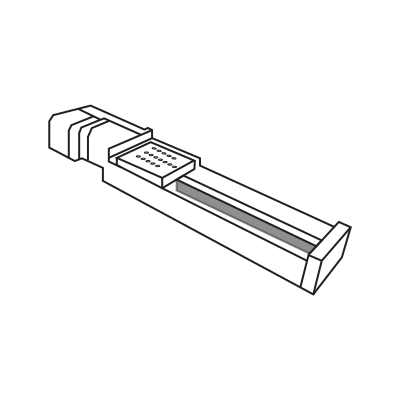
Linear stage
Contact us for a SweepMe! Pro trial license!
What are linear stages used for?
Positioning: Linear stages are used to precisely position loads or objects in a linear direction. Measurements involve determining the distance traveled or the final position.
Displacement: Measurements may include the displacement of the load from its initial position, providing information on how far the linear stage has moved.
Velocity: Some linear stages are equipped with velocity control, allowing users to set and measure the speed at which the load moves along the linear path.
Acceleration: Acceleration measurements may be relevant, especially in applications where the linear stage needs to start, stop, or change speed rapidly.
Types of linear stages
Two-Axis Stage (X-Y Stage): Assembled from two linear stages, typically mounted perpendicular to each other. Commonly used for X-Y positioning, such as in microscope stages for positioning slides.
Three-Axis Stage (X-Y-Z Stage): Composed of three linear stages mounted orthogonally to achieve motion in three perpendicular directions (X, Y, Z). They can be used in microscopy to enable volume scanning or automated focusing followed by 2D imaging.
Integrated Two-Axis Stage: A pre-designed, integrated two-axis stage where the linear stages are built into a single unit. Provides a compact solution for applications with specific space constraints.
Rotary Stage: A stage specifically designed for rotational motion around a fixed axis. It can be integrated into multi-axis configurations to provide rotary adjustments, such as four-, five, and six-axis stages.
Positioning Goniometer: Combines rotational and tilting elements to enable precise angular adjustments. Typically used for applications requiring accurate angular positioning.
Application fields of linear stages
Semiconductor manufacturing: Linear stages are used in the semiconductor devices fabrication process for precise linear positioning of wafers for the purposes of wafer mapping dielectric, characterization, and epitaxial layer monitoring
Optics and Photonics: Used for aligning optical components in laser systems, telescopes, and imaging devices.
Microscopy: Essential in microscopy setups for precise sample positioning and focus adjustment.
What are important specifications?
Travel describes the maximum distance the linear stage can traverse along its axis. Commonly measured in millimeters or micrometers (e.g. <25µm, 25-200mm, 200+mm).
Accuracy indicates how closely the linear stage can reach a specified position. It represents the deviation between the commanded position and the actual achieved position (e.g. (<10 mm, >10 m). Typically specified in micrometers (µm) or nanometers (nm).
Repeatability measures the ability of the linear stage to return to a given position consistently in repetitive movements. It is often expressed as the maximum deviation from the target position.
Speed specifies the maximum speed at which the linear stage can move. It is crucial for applications requiring rapid positioning. Given in millimeters per second (mm/s) or other velocity units (e.g. 0-33 mm/s, 45-500 mm/s, 500+ mm/s).
Manual control Some stages are equipped with manual control, enabling quick adjustments or large movements without defining positions in the software.
Linear stages and SweepMe!
Device combination: Easily combine your Linear Stage with other devices such as detectors, sensors, or light sources using SweepMe! drivers.
Custom User Interfaces: SweepMe! offers an advanced interference platform, enabling effortless control of the linear stage's position, velocity, and accumulation.
Data display SweepMe! dynamically generates real-time data plots that illustrate the fluctuations in both velocity and distance from the linear stage.
Your partner for the integration
Linear stage support and integration
Built from real lab practice
SweepMe! was founded in 2018 by Dr. Axel Fischer and Dr. Felix Kaschura after their PhDs in applied physics. Since then the company has grown into a service oriented partner for industry and research alike, and more than 100 companies and research institutes run their measurements with SweepMe! today. We know what a measurement setup has to deliver, we make the technology work for you, and we understand the science behind your data.