
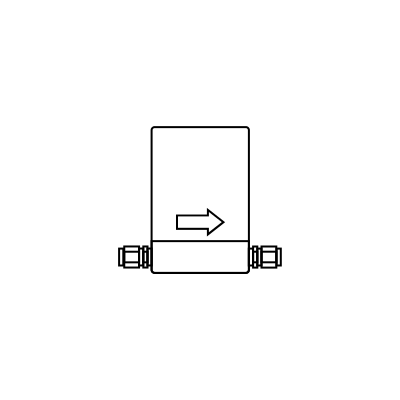
Mass flow controller
Contact us for a SweepMe! Pro trial license!
Mass Flow Controller Measurements
Air Flow Rate: In some applications, controlling air pressure involves regulating the flow rate of air. This is particularly important in systems where maintaining a specific airflow is critical.
Standard Volumetric Flow Rate: While mass flow rate is the primary concern, some applications might require the volumetric flow rate at standard conditions (often defined as 0°C and 1-atmosphere pressure).
Gas Composition: Some MFCs, particularly those designed for research or high-precision applications, can account for the type of gas flowing. This allows for more accurate mass flow measurement by considering the gas's specific properties like density and viscosity.
How does the instrument work?
A Heated Micro Channel acts like a controlled highway for gas molecules. The channel is actively heated to create a temperature difference for the measurement.
Temperature Sensors (RTDs): Two sensors positioned along the channel act like tollbooths. They measure the temperature at different points, with more gas flow carrying away more heat and creating a larger temperature difference.
Control Loop & Valve: The difference in temperature readings tells the instrument the mass flow rate. A control loop then adjusts a valve, acting like a traffic light, to maintain the desired flow rate set by the user. This ensures consistent gas delivery even with pressure or temperature fluctuations.
Applications of Mass Flow Controller
Leak Detection: During semiconductor device testing, MFCs are used to create a controlled flow of a tracer gas (like helium) into a chamber containing the device. By measuring the flow rate of the tracer gas exiting the chamber and comparing it to the inflow, even the smallest leaks in the device packaging can be identified.
Etch Rate Monitoring: In plasma etching processes used for chip fabrication, MFCs precisely regulate the flow of reactive gases like oxygen or fluorine. By monitoring the mass flow rate of these gases and correlating it with the etch depth, manufacturers can ensure consistent and precise etching of features on the chip.
Chemical Vapor Deposition (CVD) Control: MFCs play a critical role in CVD processes used to deposit thin films on semiconductor devices. They precisely control the flow of precursor gases, ensuring the correct deposition rate, thickness, and uniformity of the deposited film. This is crucial for device performance and functionality.
Calibration of Gas Analyzers: Many gas analyzers used in semiconductor manufacturing rely on MFCs for the controlled delivery of calibration gases. This ensures the accuracy and reliability of the analyzers when measuring the composition of process gases or contaminants in the environment.
Process Gas Blending: For specific processes, precise mixtures of different gases might be required. MFCs can be used in combination to accurately control the flow rates of individual gases, creating the desired gas mixture for the specific application within semiconductor testing or measurement.
What are important specifications?
Maximum flow rate: Maximum Flow Rate represents the highest flow rate of fluid or gas that the pressure controller can handle effectively.
Pressure Range: This defines the minimum and maximum pressure the controller can regulate. Select a controller with a pressure range that encompasses your desired operating pressure for optimal performance.
Outlet Pressure Accuracy: This indicates how precisely the controller can maintain the set pressure at the outlet. Accuracy is usually expressed as a percentage of the full-scale pressure range (e.g., ±1% of full scale).
Response Time: This specifies the time it takes for the controller to react to a change in pressure and adjust the output to reach the desired setpoint. A faster response time is essential for applications requiring rapid pressure adjustments.
Control Interface: Pressure controllers can have various control interfaces, including analog (e.g., 0-10V) or digital (e.g., RS-232) interfaces. Choose one compatible with your data acquisition system or other control devices.
Material Compatibility: The materials used in the pressure controller, particularly those in contact with the fluid, should be compatible with the type of gas or liquid you'll be using. This ensures safe and reliable operation.
Mass flow controller and SweepMe!
Seamless Integration: SweepMe! allows for the effortless integration of Mass Flow Controllers (MFCs) into laboratory setups. Users can easily connect and control MFCs directly within the SweepMe! software environment.
Automated Control: SweepMe! enables automated control of MFCs, allowing users to set desired flow rates, initiate gas flow adjustments, and monitor real-time flow measurements. This automation streamlines experimental processes and reduces manual intervention.
Real-time Monitoring: With SweepMe!, users can monitor gas flow parameters in real time, enabling immediate adjustments and ensuring precise control over experimental conditions. Real-time monitoring facilitates data-driven decision-making and enhances experimental efficiency.
Data Acquisition and Analysis: SweepMe! provides tools for data acquisition, analysis, and visualization. Users can collect gas flow data from MFCs alongside other experimental parameters, analyze the data, and visualize trends or correlations. This comprehensive approach allows for in-depth analysis of experimental results.
Your partner for the integration
Mass flow controller support and integration
Built from real lab practice
SweepMe! was founded in 2018 by Dr. Axel Fischer and Dr. Felix Kaschura after their PhDs in applied physics. Since then the company has grown into a service oriented partner for industry and research alike, and more than 100 companies and research institutes run their measurements with SweepMe! today. We know what a measurement setup has to deliver, we make the technology work for you, and we understand the science behind your data.