
Monochromator
Contact us for a SweepMe! Pro trial license!
Monochromator Measurements
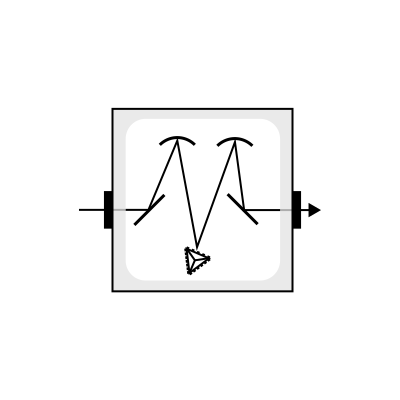
Wavelength Selection: Monochromators are engineered to disperse light into its constituent wavelengths and selectively transmit a single wavelength or a narrow band of wavelengths.
Multiple Monochromators: If a very narrow wavelength line is needed multiple monochromators can be combined to remove residual stray light. In this case, a photo-multiplier tube (PMT) is often used to detect the very weak signal that remains.
An alternative to a monochromator can be a tunable wavelength laser. The advantage of a laser is, that the light is very monochromatic and intense, but typically a smaller range of wavelengths is covered.
How does a monochromator work?
Light Source: The process begins with a light source that emits a broad spectrum of light, often white light containing various wavelengths.
Entrance Slit: The light enters the monochromator through an adjustable entrance slit. The slit helps control the amount of light that enters the system.
Dispersion Element: The primary function of the monochromator is to disperse the incoming light into its constituent wavelengths. This is achieved using a dispersive element, which can be a diffraction grating or a prism.
Diffraction Grating: If a diffraction grating is used, it consists of closely spaced lines or grooves that diffract light at different angles depending on its wavelength. Each wavelength is dispersed spatially.
Prism: In the case of a prism, different wavelengths of light are refracted by different amounts as they pass through the prism, leading to spatial separation.
Exit Slit: After dispersion, the monochromator has an adjustable exit slit. This slit allows the selection of a specific wavelength or a narrow range of wavelengths to pass through.
Selected Wavelength: The selected wavelength or range of wavelengths exits the monochromator and can be directed to other optical components or detectors for further analysis.
Adjustability: One key feature of monochromators is their adjustability. Users can change the wavelength of interest by adjusting the positions of the entrance and exit slits and, in the case of a diffraction grating, by changing the angle of the grating.
Application fields
Spectroscopy: Used in optical and infrared spectroscopy for precise measurements of absorption, emission, or scattering of light by materials.
Optoelectronics: Used in optoelectronic devices for sensitive detection and analysis of optical signals.
Materials Science: Applied for materials characterization, especially in impedance spectroscopy and studies involving low-level electrical signals.
Optical Imaging and Microscopy: Employed in imaging and microscopy techniques to enhance signal quality and sensitivity.
What are important specifications?
Focal Length (300 mm): The focal length is the distance between the lens or mirror and its focal point. In this context, a focal length of 300 mm indicates that the optical system focuses incoming light at a point 300 mm away from the lens or mirror. This focusing enables the monochromator to isolate and direct specific wavelengths of light onto a sample or detector.
Aperture (f/6): The aperture is the opening through which light enters the optical system. The f/6 specification represents the f-number or f-stop, which is the ratio of the focal length to the diameter of the entrance pupil. In this case, f/6 suggests that the aperture diameter is one-sixth of the focal length. The slit width of the entrance and exit slits in a monochromator is directly related to the aperture size. A wider aperture allows more light to enter the monochromator, enabling a larger range of wavelengths to be captured.
Number of Gratings: This specification indicates the quantity of diffraction gratings within the optical system. It may have implications for the versatility or specialization of the instrument.
Number of Entrance Ports: The number of entrance ports specifies how many openings or ports are available for light to enter the optical system. Multiple entrance ports can be useful in certain applications, allowing for different light sources or configurations.
Entrance Slit Width: The entrance slit width refers to the adjustable opening through which light enters the optical system. It is measured in millimeters and can be adjusted to control the amount of light entering, affecting factors such as resolution and light intensity.
Wavelength dependence: A monochromator's efficiency does vary across different wavelengths, and this can indeed alter the final spectrum you measure from your light source. To account for this variation, researchers often use a calibrated detector like a photodiode to measure the monochromator's efficiency across the desired wavelength range. This creates a correction function that can then be applied to the final measured spectrum to compensate for the monochromator's bias.
Monochromators and SweepMe!
Device control: SweepMe! can be employed to control the optical system, adjusting parameters such as the entrance slit width, grating position, and other settings. It serves as a versatile platform for automation and precision control.
Device combination: SweepMe! allows users to easily combine a monochromator with a spectrometer to check the wavelength distribution.
Measurement automation: SweepMe! allows to easily define when gratings must be switched as they only work for a certain wavelength range. Thus, one can easily make a wavelength scan and SweepMe! automatically uses the correct gratings.
System integration: SweepMe! can facilitate the integration of the optical system with other instruments or sensors in a laboratory setup. This integration enables synchronized measurements and data acquisition across different instruments.
SweepMe! in practice
Monochromator in real measurement setups
Your partner for the integration
Monochromator support and integration
Built from real lab practice
SweepMe! was founded in 2018 by Dr. Axel Fischer and Dr. Felix Kaschura after their PhDs in applied physics. Since then the company has grown into a service oriented partner for industry and research alike, and more than 100 companies and research institutes run their measurements with SweepMe! today. We know what a measurement setup has to deliver, we make the technology work for you, and we understand the science behind your data.