
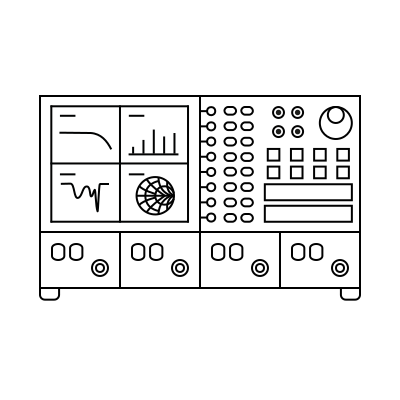
Network analyzer
Contact us for a SweepMe! Pro trial license!
What does a Network analyzer measure?
Reflection Coefficient (S11): Represents the portion of the incident signal that is reflected from the input port. It indicates how well a device or component matches the impedance of the system.
Transmission Coefficient (S21): Indicates the amount of signal transmitted from the input port to the output port. It is crucial to understand the signal transfer characteristics of the network or device.
Gain (S21 in dB): Represents the ratio of the output power to the input power in decibels. It quantifies the amplification or attenuation of the signal through the device.
Insertion Loss (S21 in dB): Measures the signal power loss through a device, such as cables, connectors, or filters. It is the negative of the gain in decibels.
Isolation (S12): Indicates the extent to which the output port is isolated from the input port. High isolation is desirable in applications where signal leakage between ports is undesirable.
Transmission Phase (S21 Phase): Provides information about the phase shift introduced by the network or device as a function of frequency.
Return Loss (S11 in dB): Complements the reflection coefficient and quantifies the amount of power reflected from the device. Higher return loss indicates better impedance matching.
Smith Chart Display: Provides a graphical representation of impedance in the complex plane, aiding in impedance matching and tuning.
How does the instrument work?
Generate Signals: The network analyzer creates signals, like radio waves, covering a range of frequencies.
Send Signals to Device: These signals are sent to the device you want to test (Device Under Test or DUT).
Measure Responses: The analyzer measures how much of the signal goes through the device (transmission) and how much it bounces back (reflection).
Calculate S-Parameters: The measurements are processed to calculate S-parameters. These numbers describe how the device affects signals at its input and output. The key S-parameters include
S11: Reflection coefficient at the input port.
S21: Transmission coefficient from input to output.
S12: Transmission coefficient from output to input.
S22: Reflection coefficient at the output port.
Display Results: The results are shown on a screen, often as graphs or charts, helping you understand how the device behaves at different frequencies.
In which application fields are they used?
RF and Microwave Engineering: Characterizing and optimizing the performance of RF and microwave circuits, antennas, filters, and amplifiers.
Telecommunications: Analyzing communication systems, evaluating signal integrity, and ensuring efficient transmission through cables and connectors.
Automotive Electronics: Analyzing and testing electronic components in vehicles, including radar systems, infotainment systems, and communication modules.
Semiconductor Industry: Analyzing semiconductor devices, including RF integrated circuits, to ensure their proper functioning in communication and electronic systems.
Electromagnetic Compatibility (EMC) Testing: Assessing and ensuring that electronic devices comply with electromagnetic compatibility standards to avoid interference and ensure proper functioning in diverse environments.
What are important specifications?
Maximum Frequency: A maximum frequency is the highest frequency it can measure. Network analyzer receivers contain analog-to-digital converters (ADC) that convert incoming signals into a digital format. These signals can then be analyzed and displayed. The ADC cannot convert signals at radio frequencies, so incident signals must be down-converted to the ADC�s operating frequency. This operating frequency is called the intermediate frequency (IF).
Dynamic Range: Dynamic range is the power range over which the response of a component is measured. Reflects the analyzer's sensitivity and ability to measure weak signals in the presence of stronger ones.
Output Power: The output power indicates how much power the Network Analyzer signal generator and test set can send into the DUT. It is expressed in dBm and references a 50-ohm impedance to match the characteristic impedance of most RF transmission lines. High output power is useful to improve the signal-to-noise ratio of a measurement or to determine the compression limit of a DUT.
Trace noise is noise that you see superimposed on DUT responses because of random noise in the system. It can make the signal look not smooth or even jittery. Trace noise is mitigated by increasing test power, lowering the receiver�s bandwidth, or by averaging.
Network Analyzer and SweepMe!
Instrument Control: SweepMe! provides drivers and libraries that allow users to communicate with and control network analyzers. This enables the automation of measurement tasks and the integration of network analyzers into larger test systems.
Data Acquisition: SweepMe! can be used to acquire, process, and visualize data obtained from network analyzers. This is particularly useful for real-time monitoring and analysis of network behavior.
Customized Test Sequences: SweepMe! allows engineers to design custom test sequences and measurement routines for network analyzers. This flexibility is valuable in creating tailored testing procedures for specific applications.
Automation of Repetitive Tasks SweepMe! enables the automation of repetitive measurement tasks, reducing the time required for testing and enhancing the efficiency of the overall measurement process.
Integration with Other Instruments: SweepMe! serves as a central platform for integrating network analyzers with other instruments such as wafer probers or power supplies in a test setup. This integration simplifies complex measurement systems.
SweepMe! in practice
Network analyzer in real measurement setups
Your partner for the integration
Network analyzer support and integration
Built from real lab practice
SweepMe! was founded in 2018 by Dr. Axel Fischer and Dr. Felix Kaschura after their PhDs in applied physics. Since then the company has grown into a service oriented partner for industry and research alike, and more than 100 companies and research institutes run their measurements with SweepMe! today. We know what a measurement setup has to deliver, we make the technology work for you, and we understand the science behind your data.