
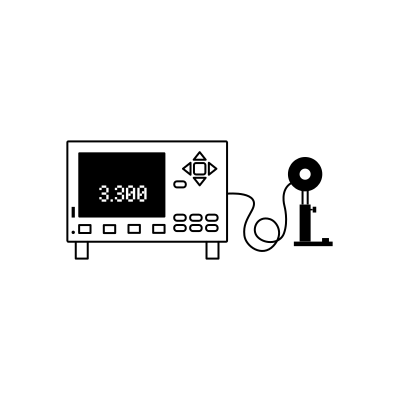
Optical power meter
Contact us for a SweepMe! Pro trial license!
What does an optical power meter measure?
Absolute Power Measurements refer to the process of quantifying the total optical power of a light signal without comparing it to any reference, typically given in Watt (W).
Transmittance Measurements measure the proportion of optical power that passes through (i.e. transmits) a medium or component, expressed as a percentage.
Reflectance Measurements are the opposite of transmittance measurements. They quantify the amount of light that is reflected from a surface or interface, expressed as a percentage.
Fiber Optic Power Output Measurements involve quantifying the optical power emitted from the output end of a fiber optic source or device.
Types of Optical Power Meter
Photodiode-based Optical Power Meters: These OPM use a photodiode to convert incoming optical power into an electrical current. The current is then measured to determine the optical power.
Thermopile Optical Power Meters: Thermopile sensors use the temperature change caused by the absorbed optical power to measure the incident power.
Silicon (Si) detectors excel in the visible spectrum and at 850 nm, offering reliable performance. However, they tend to saturate at low power levels, limiting their use for high-intensity signals and beyond the specified range.
Germanium (Ge) detectors saturate at high power levels, suitable for strong optical signals. Yet, they have drawbacks, including poor low-power performance, limited accuracy at 1550 nm, and non-linearity at low power levels.
Indium Gallium Arsenide (InGaAs) detectors strike a balance, saturating at intermediate power levels. They provide generally good performance, especially in single-mode fiber testing (1270 - 1650 nm), with some sensitivity around 850 nm. InGaAs detectors find extensive use in applications requiring a compromise between sensitivity, power range, and wavelength coverage
Pyroelectric Optical Power Meters generate a voltage when exposed to light, and this voltage is proportional to the incident optical power.
Calorimetric Optical Power Meters measure the temperature rise caused by the absorbed optical power, allowing for power determination.
Which application fields use optical power meters?
Fiber Optic Network Testing: Optical power meters are extensively used for testing the performance of fiber optic networks. They measure signal strength, ensuring that transmitted power levels meet standards for reliable communication.
Optical Component Characterization: In research and development, optical power meters assist in characterizing the performance of optical components such as lasers, amplifiers, and attenuators.
Wavelength Verification: Optical power meters are employed to verify the wavelength of optical signals, crucial for maintaining proper alignment and compatibility in communication systems.
Testing Laser Systems: Optical power meters are crucial for testing and calibrating laser systems. They measure laser power accurately, ensuring compliance with safety standards and system specifications.
Silicon Photonics: This rising field integrates photonic components onto silicon chips. Optical power meters are crucial for characterizing these circuits by measuring light power in waveguides and devices, ensuring proper function and design compliance.
What are important specifications?
Wavelength range: The range of wavelengths the power meter is designed to measure. Ensure it covers the specific wavelengths relevant to your application.
Power Range: The range of optical power levels the meter can accurately measure. Consider the expected power levels in your system to choose an appropriate range.
Calibration Accuracy: The accuracy of the power meter's calibration. This indicates how closely the measured values align with actual power levels and is crucial for reliable measurements.
Resolution: The smallest change in power that the meter can detect. Higher resolution allows for more precise measurements, particularly in applications where small power variations are significant.
Detector Type: Different types of detectors (e.g., Si, Ge, InGaAs) have varying characteristics.
Polarization Dependence: Some optical power meters may be sensitive to the polarization state of the incoming light.
Optical power meter and SweepMe!
Instrument Control: SweepMe! provides functionality for instrument control, enabling users to interface with optical power meters seamlessly. Through SweepMe!, users can send commands to the power meter, set measurement parameters, and retrieve measurement data.
Data Acquisition SweepMe! can be used to acquire and log data from optical power meters. This includes capturing power readings over time, measuring power levels at different wavelengths, or performing other data acquisition tasks relevant to optical measurements.
Integration with Other Instruments: In a laboratory setup involving multiple instruments, SweepMe! acts as a central hub, integrating various instruments like optical power meters, including monochromators and lasers, within a testing setup. This seamless integration enables a cohesive approach to data acquisition and analysis, streamlining the testing process.
Your partner for the integration
Optical power meter support and integration
Built from real lab practice
SweepMe! was founded in 2018 by Dr. Axel Fischer and Dr. Felix Kaschura after their PhDs in applied physics. Since then the company has grown into a service oriented partner for industry and research alike, and more than 100 companies and research institutes run their measurements with SweepMe! today. We know what a measurement setup has to deliver, we make the technology work for you, and we understand the science behind your data.