
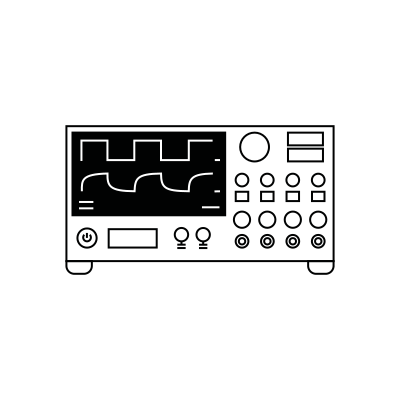
Oscilloscope
Contact us for a SweepMe! Pro trial license!
What does an Oscilloscope measure?
Voltage Measurement: Oscilloscopes are commonly used to measure the voltage of electrical signals. Users can observe the amplitude (peak-to-peak or RMS), peak voltage, and other characteristics of the signal.
Current Measurement: Current cannot be measured directly. However, one can use a shunt resistor with a well-defined resistance to measure the current flow through it via its voltage drop or one can use special current probes that use operational amplifiers to create a voltage that is proportional to the current. A strategy to measure large currents is clamps that create a voltage based on the induction of a nearby current flow.
Time Measurements: Oscilloscopes provide precise time-domain measurements. Users can measure time intervals, frequencies, rise times, fall times, and other time-related parameters of the electrical signal.
Frequency Analysis: Oscilloscopes can perform frequency analysis by using Fast-Fourier-Transform (FFT) or other frequency domain analysis techniques. This allows users to observe the frequency components present in a signal.
Waveform Shape Analysis: Users can analyze the shape and characteristics of waveforms, including sine waves, square waves, triangular waves, and more. This is essential for assessing signal integrity and identifying distortions.
Phase Measurements: Oscilloscopes enable users to measure phase differences between two or more signals. This is crucial for analyzing the synchronization and timing relationships in electronic systems.
Pulse and Edge Measurements: Oscilloscopes can measure parameters related to pulses and edges, such as pulse width, pulse repetition interval, and edge rise/fall times.
Which measurement modes exist?
Time Domain Mode: The standard mode where the oscilloscope displays voltage versus time. This mode provides a waveform representation of the input signal, allowing users to observe signal characteristics over time.
Frequency Domain Mode (FFT): Oscilloscopes can perform a Fast Fourier Transform (FFT) to convert signals from the time domain to the frequency domain. This mode allows users to analyze the frequency components present in the signal, providing insights into the signal's spectral content.
XY Mode (Lissajous Patterns): In this mode, the oscilloscope displays one signal on the horizontal axis and another on the vertical axis, creating Lissajous patterns. XY mode is useful for phase and frequency relationship analysis between two signals.
Zone Triggering Mode: Zone triggering mode allows users to define specific regions on the waveform where triggering should occur. This is useful for isolating and capturing specific events or anomalies in the signal.
Application fields
Electronics and Electrical Engineering: Oscilloscopes are fundamental tools for electronics and electrical engineers to analyze and troubleshoot electronic circuits. They help visualize and measure voltage waveforms, frequency, and timing characteristics.
Signal Integrity Testing: Oscilloscopes are extensively used in signal integrity testing to ensure that signals maintain their quality and integrity throughout electronic systems. This is crucial in high-speed digital and analog designs.
Network Analysis: In the field of network analysis, oscilloscopes are employed for measuring and analyzing signals in communication networks. This includes assessing signal transmission, reflections, and overall network performance.
Power Supply Testing: Engineers use oscilloscopes to test and analyze voltage waveforms from power supplies. This helps ensure stable and reliable power delivery to electronic components.
What are important specifications?
Bandwidth: Bandwidth refers to the range of frequencies that an oscilloscope can accurately capture and display. It is typically expressed in Hertz (Hz). The bandwidth specification indicates the upper limit of frequencies for which the oscilloscope can provide reliable measurements.
Channels: The number of channels on an oscilloscope represents how many independent signals the oscilloscope can measure simultaneously. Common oscilloscopes have 2 or 4 channels, allowing users to observe multiple signals or different parts of a circuit simultaneously.
Sample rate: Sample rate indicates the number of data points the oscilloscope can capture per second. It determines how accurately the oscilloscope can reconstruct the waveform. A higher sample rate allows for capturing fast-changing signals with more detail.
Max. memory depth: Memory depth refers to the amount of data points an oscilloscope can store for each channel. A deeper memory allows for capturing and analyzing longer time intervals with more detail.
Optional MSO: An MSO is an oscilloscope that combines analog signal measurement capabilities with digital logic analysis. It typically includes digital channels for analyzing and correlating digital signals alongside analog waveforms.
Oscilloscopes and SweepMe!
Instrument Control: SweepMe! is often used to control oscilloscopes, providing a graphical interface for users to set parameters, initiate measurements, and retrieve data. This enables automated testing and measurement processes.
Data Acquisition: SweepMe! interfaces seamlessly with oscilloscopes for data acquisition purposes. It can collect, store, and analyze waveform data from the oscilloscope, making it a versatile tool for monitoring and recording signals.
Customized User Interfaces: SweepMe! does not directly create customized graphical user interfaces (GUIs) for oscilloscopes, it does facilitate the retrieval of data, saving files for multiple channels, and displaying them in plots. The "Scope" module within SweepMe! offers a common interface to set up these devices.
Data Analysis and Visualization: SweepMe! includes tools for data analysis and visualization. Engineers can use SweepMe! to process waveform data from oscilloscopes, perform calculations, and present results in graphical formats for better interpretation.
Integration with Other Instruments: SweepMe! serves as a central hub for integrating various instruments including signal generators, power supplies, and many more within a laboratory setup. This integration streamlines experimental configurations and data collection processes.
Remote Monitoring and Control: SweepMe!'s networking capabilities enable remote monitoring and control of oscilloscopes. This is advantageous for applications where physical access to the oscilloscope may be limited.
SweepMe! in practice
Oscilloscope in real measurement setups
Your partner for the integration
Oscilloscope support and integration
Built from real lab practice
SweepMe! was founded in 2018 by Dr. Axel Fischer and Dr. Felix Kaschura after their PhDs in applied physics. Since then the company has grown into a service oriented partner for industry and research alike, and more than 100 companies and research institutes run their measurements with SweepMe! today. We know what a measurement setup has to deliver, we make the technology work for you, and we understand the science behind your data.