
Power supply
Contact us for a SweepMe! Pro trial license!
What does a power supply regulate?
Output Voltage refers to the voltage level provided by the power supply or electronic component to the load or circuit it is connected to.
Output Current refers to the flow of electric charge delivered by the power supply or electronic component to the load.
Voltage regulation is the ability of a power supply or electronic component to maintain a consistent output voltage despite changes in input voltage or load conditions.
Load regulations is the ability of a power supply or electronic component to maintain a consistent output voltage or current as the load changes.
Testing electronic components: Power supplies are commonly used to test electronic components such as DC/DC converters, operational amplifiers, and other circuitry.
Which measurement modes and basic handling exist?
Constant Voltage (CV) Mode: Lab power supplies can operate in constant voltage mode, where they maintain a steady voltage output regardless of changes in load resistance or current draw. This mode ensures that the voltage across the load remains constant.
Constant Current (CC) Mode: In constant current mode, the power supply regulates the output current to remain constant regardless of variations in load resistance or voltage. This mode is particularly useful for applications where a specific current level needs to be maintained, such as charging batteries or driving LEDs.
Automatic Switching Between CV and CC Modes: Lab power supplies often feature automatic switching between constant voltage and constant current modes based on the load conditions. This ensures optimal operation and protection for both the power supply and the connected load.
Adjustable Voltage and Current Limits: Users can set voltage and current limits on lab power supplies to protect sensitive devices and prevent overloading. These limits can be adjusted to suit the requirements of the connected circuit or experiment.
Remote Control and Programming: Many lab power supplies offer remote control and programming capabilities, allowing users to adjust settings and monitor output parameters remotely via computer interfaces such as USB, Ethernet, or GPIB.
Bipolar Output: Some lab power supplies can provide both positive and negative voltages, known as bipolar output. This feature is essential for applications requiring dual-polarity voltage sources, such as operational amplifiers and audio equipment.
Overvoltage and Overcurrent Protection: Lab power supplies often include built-in protection mechanisms to safeguard against overvoltage and overcurrent conditions. These protections help prevent damage to the power supply and the connected load.
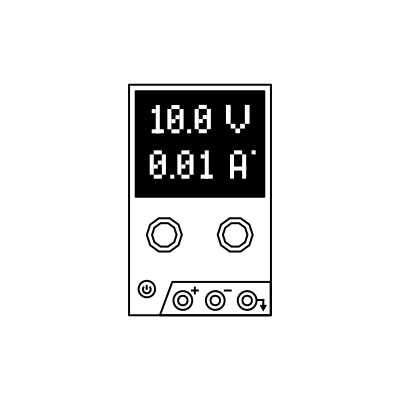
Digital Display and Monitoring: Lab power supplies typically feature digital displays that provide real-time monitoring of output voltage, current, and other parameters. This allows users to easily track and adjust settings as needed during experiments or testing.
In which application fields they are used
Series and parallel power supplies can provide a larger output:
Series: Increases output voltage while maintaining current capability.
Parallel: Increases total current output while maintaining voltage level.
Electronic Labs: Lab power supplies are foundational components in electronic labs, where they are used for prototyping, testing, and troubleshooting electronic circuits and devices.
Electronics Testing and Development: Lab power supplies play a crucial role in the testing and development of electronic systems and components. They provide stable and adjustable power sources for powering and evaluating circuits, ensuring that devices meet performance specifications and reliability standards.
Semiconductor Manufacturing In semiconductor manufacturing facilities, lab power supplies are used during the testing and characterization of semiconductor devices such as integrated circuits (ICs), transistors, and diodes.
What are important specifications?
Current Output Range (0-5 A): It provides the capability to supply varying amounts of current to accommodate different load requirements and ensure proper operation of connected devices.
Output Type (DC - Direct Current): DC is commonly used in electronic circuits and devices, making this power supply suitable for powering a wide range of electronic components.
Adjustability: This adjustability allows users to precisely control the output levels to match the requirements of their experiments or electronic projects.
Display (4-Digit LED Display): This display provides users with clear and accurate readouts, allowing them to monitor the output levels in real-time.
Power supplies and SweepMe!
Remote control: SweepMe! enables automated control of power supply outputs.
Device combination: Easily combine your power supply with various other devices supported in SweepMe!, such as SMUs, parameter analyzers, and switching matrices.
Your partner for the integration
Power supply support and integration
Built from real lab practice
SweepMe! was founded in 2018 by Dr. Axel Fischer and Dr. Felix Kaschura after their PhDs in applied physics. Since then the company has grown into a service oriented partner for industry and research alike, and more than 100 companies and research institutes run their measurements with SweepMe! today. We know what a measurement setup has to deliver, we make the technology work for you, and we understand the science behind your data.